SEfari Fellowship on quantifying ‘Ag of the middle’ in the North Highlands of Scotland
NHI is delighted to partner up with the Food Farming and Countryside Commission (FFCC), Scottish Crofting Federation (SCF) and Scottish Agricultural Organisation Society (SAOS) for a new SEFARI Gateway Fellowship on quantifying ‘Ag of the middle’ in the North Highlands of Scotland.
Background
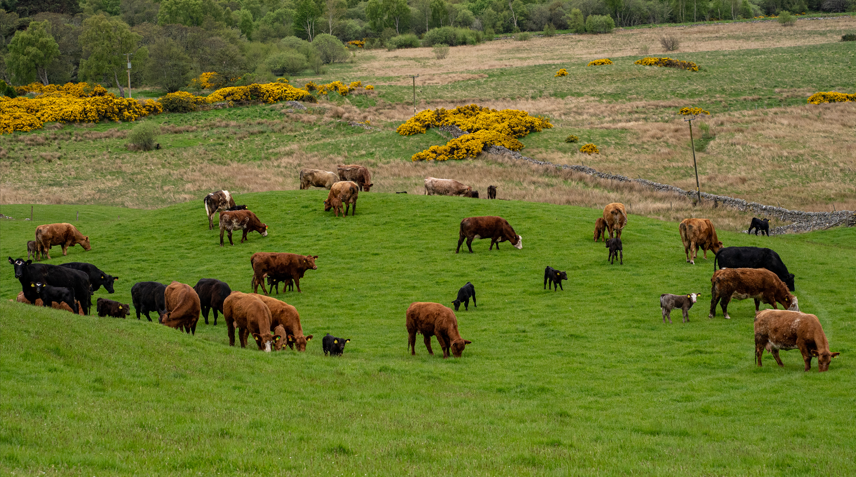
The North Highlands, which include Caithness, Sutherland, and Ross & Cromarty, are a unique region. The region has diverse geography and geology comprising of thousands of individuals farms and crofts. However due to its challenging land quality, the region is almost entirely classified as ‘Less Favoured Area – Severely Disadvantaged’. While it may seem difficult to produce food here, embracing innovative farming methods opens doors to redefining this perception. Sheep, cattle, and beef form the main agricultural activity, but general cropping, horticulture, and mixed farming, amongst others, form part of the regional picture.
‘Agriculture of the middle’ (AOTM) producers are small to medium sized producers that supply food to farmer’s markets, but which are not large enough to be part of the global food system. To achieve an agricultural transition to more sustainable and regenerative farming practices, intensive farming systems need to change. Developing AOTM may offer the potential to carry out regenerative agriculture at scales that can supply local tourism outlets (hotels & restaurants), local shops and supermarkets with produce from more local sources.
In a joint project between SEFARI Gateway, NHI, FFCC, SCF and SAOS, the “Quantifying ‘Ag of the middle’ in the North Highlands of Scotland” research project plans to evaluate the ways that crofts and small to medium sized farms and their markets can become more resilient through playing to their strengths – whether this is increasing their food outputs, increasing the quality of their produce to decommoditise their output, economies of scope & scale and routes to local and regional markets.
The ‘Ag of the middle’ Fellowship proposal will be focused on small to medium sized producers in the North Highlands region of Scotland, along with the local and regional supply chains for their produce and the local/regional food economies in general. The research will focus on (a) the potential for agroecological and regenerative practices in such units to further add to the evidence base for Scotland’s sustainable and regenerative farming transition and policy development and (b) the supply-chain infrastructure needed to support such a transition. This research would build on the earlier SEFARI research “The adoption of agroecological principles in Scottish farming and their contribution towards agricultural sustainability and resilience.
The Fellowship
The Fellowship aims to establish what farms and crofts in the North Highlands could already be considered AOTM, what potential there is for more AOTM farming, and what models and pathways might be feasible in developing AOTM models and practises in the region. The Fellowship will focus on the opportunities offered by agroecological, sustainable and regenerative farming.
The fellowship will have several outcomes, namely:
- Increased understanding of the agricultural make-up of the North Highlands and its potential role in agricultural transition.
- New information on opportunities to scale less intensive agroecological farming practises for small to medium sized farms and crofts, including how such practices might feature in thinking for agricultural and rural development payment programmes.
- Increased understanding of the supply-chain infrastructure and other limiting factors beyond the farm which impact on any transition.
The prioritisation of outputs will be agreed with the successful fellow but key objectives are :
- An assessment and mapping of the agricultural make-up of the North Highlands region from an agroecological and AOTM perspective. The current state data and mapping is already available, but the agroecological and AOTM perspective will be focused in on this work.
- A preliminary analysis of options and pathways for adopting practices for AOTM in the North Highlands region, and considerations for other parts of Scotland. Consideration will need to be given to the region’s changing climate.
- A map of the beyond-the-farm routes to market (supply chain) and potential options for adapting it to facilitate a just transition in the local and regional food system.
- Suggestions for how potential options and pathways could be considered in agricultural and rural development payment programmes.
It is anticipated that the outputs of this SEFARI Fellowship would be disseminated to a wide range of audiences, but specifically to be shared amongst industry (farmers, crofters and land managers), through the Agriculture Reform Implementation Oversight Board (ARIOB), web sites of the project partners, and at events such as the Royal Highland Show (RHS).
Methods
The intention is that the research:
- Would apply mixed methods: i.e. a mix of desk research, existing data and mapping review, one to one interviews, and focus group discussions.
- Include interviews and group meetings, which could be a mix of online and in-person to make best use of resources and people’s availability, increase inclusivity, and to reduce carbon footprint.
- Data will be stored according to GDPR regulations and analysed using appropriate approaches: i.e. thematic analysis of qualitative data, and descriptive statistical analysis of quantitative materials.
Practicalities
Applicants are invited from staff members of the SEFARI institutions, Strategic Portfolio Centres of Expertise or UK Higher Education Institutions.
The Fellowship will be available immediately from award and will have a maximum duration of 28 days FTE (to maximum available funding for the Fellow’s time, travel and subsistence of £20K) with the precise duration and Fellow’s time allocation to that, to be mutually agreed with the successful but to conclude by 30th March 2024. We are open to proposals from individuals and groups. for group applications, a lead should be clearly identified. Please note that costs should be submitted net of VAT recovered by the applicant. Applicants should seek advice on appropriate VAT treatment of proposed funding.
Bespoke support will be given by SEFARI Gateway staff, FFCC, SAOS and NHI to the Fellow to help with the identification of, and introduction to, key individuals, organisations and actors necessary to undertake the project, including funding for a workshop(s) as part of the project (to maximum £5k). The successful Fellow will also receive support from specific colleagues in SEFARI Gateway and FFCC and NHI to act as mentors and support.
How to Apply
In applying for this Fellowship, please bear in mind that:
- Applicants must have the support of their organisation. Sign-off should be at the level deemed appropriate for each organisation (please talk to your line manager, who should ensure the Director is at least aware of the application);
- The taking up of such an opportunity should not result in a candidate going beyond the end of any agreed contract they may have with their employer;
- The maximum support for the Fellow’s time is £20,000 and SEFARI Gateway will assist with negotiations relating to duration and set-up of the Fellowship. This budget should cover salary, travel, expenses and any accommodation requirements;
- If a workshop is required as part of the ongoing Fellowship, this will be costed in separate discussion with SEFARI Gateway;
- It is recognised that individual circumstances are different and support levels will vary depending on salary, distance from the opportunity and so on – the support level will be kept under review to try and maintain fair and equitable competition and process;
- A short final report (including spatial data/maps) for the Stakeholders/Gateway and an online Case Study are required at the end of the Fellowship.
Applications should be made to info@sefari.scot and should include a cover letter (two pages of detail on your suitability) and a two-page CV. Decisions on who to interview will be based solely on this letter and your CV. The cover letter should cover:
- Why you are interested in this opportunity and what you hope to get from it;
- What skills you would bring to the role;
- What experience you bring to the role;
- What you would do to take the learning back into the Strategic Research Portfolio and/to your organisation.
The closing date for applications to this Fellowship is 5pm on the 15th November 2023 with interviews to be held in the two weeks following on from that date.
Team-based applications should demonstrate how they propose to manage individual contributions to satisfy the project requirements.
For more information please contact: Lorna Dawson (SEFARI Gateway Knowledge Broker for Climate and Environment) lorna.dawson@hutton.ac.uk or Charles Bestwick (SEFARI Gateway Director) c.bestwick@abdn.ac.uk.
What to read next…
The John o’ Groats Trail: Building Bridges and Transforming the Highlands
The John o’ Groats Trail: Building Bridges and Transforming the Highlands At North…

Supporting Mental Health and Well-being Projects Across the North Highlands

Brora Development Trust Secures NHI Funding Support

